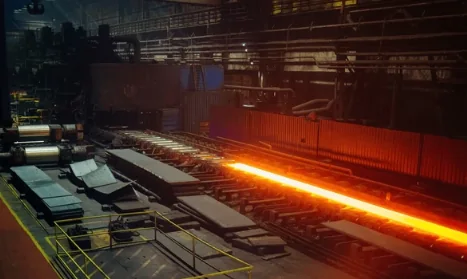
A controlled monitoring plan
The architecture that connects installation boundaries, production routes, goods and CN codes to source streams, methods, meters and controls.
Requirements

The definitive regime has applied since 1 January 2026. We say exactly where our accreditation stands, and we do not sell what has not been granted.
A controlled monitoring plan, production and precursor data that can be traced to source, and a file that survives independent examination — under Regulation (EU) 2023/956 and the implementing acts that govern the definitive period.
Energy Up International's application for accreditation as a CBAM verifier has been formally accepted by ACCREDIA under case C DC 07/2026, and the assessment process is underway. Accredited CBAM verification will be offered only after formal accreditation is granted and only within the approved scope.
What we offer today: a non-accredited readiness review of the evidence file with full team separation; general training on CBAM requirements; and product carbon footprint verification under ISO 14067, but only for products inside the published EGAC scope. None of these outputs is marketed as a CBAM verification report.
The authorised CBAM declarant inside the European Union carries the annual declaration and certificate-surrender obligations. The operator outside the EU supplies installation and embedded-emissions data. But the quality of that data decides whether actual values can be used instead of defaults — and that is where the commercial difference lives.
Since 2026 the mechanism applies to importers above a single mass threshold of 50 tonnes of CBAM goods per year. The first annual declaration, covering 2026 imports, falls due by 30 September 2027. Source: European Commission — CBAM definitive regime, checked 01 September 2026.
The architecture that connects installation boundaries, production routes, goods and CN codes to source streams, methods, meters and controls.
RequirementsInstallation, process flow, production, source streams, fuels, electricity, measurement, sampling, factors, precursors and the calculation workbook.
ChecklistThe easier value is not automatically the cheaper value. Understand what each choice costs before the reporting period, not during it.
CompareScreen your CN codes against the published goods list and find the sector, category, emissions treatment and precursors.
Check a CN codeOperator, declarant, verifier, Registry and first-declaration dates, each with its official source and checked date.
TimelineNine controlled stages from pre-engagement to the report in the CBAM Registry — explained now, offered after accreditation.
Process Cement
Splitting process CO₂ from combustion CO₂. Calcination emissions come from the raw meal, not the fuel, and need the carbonate content of the raw mater…
2507 00 80 Iron and steel
Scrap share and its treatment. Scrap is not carbon-free in the accounting sense once it moves between installations; the input record has to distingui…
2601 12 00 Aluminium
PFC quantification. Anode effect frequency and duration, or the slope method, with instrument records behind them. This is the number most often estim…
7601 Fertilisers
N₂O measurement at the nitric acid plant. Continuous measurement, abatement uptime and the treatment of start-up and shutdown periods. Averages that q…
2808 00 00 Electricity
Which value applies. Actual values are only permitted where the Regulation’s conditions are met; otherwise a default applies. This is a legal test bef…
2716 00 00 Hydrogen
Capture rate evidence. A design capture rate is not a measured capture rate. Continuous metering, availability and the destination of the captured CO₂…
2804 10 00Not yet. Our application has been formally accepted by ACCREDIA under case C DC 07/2026 and the assessment is underway. Accredited CBAM verification will be offered only after accreditation is granted, and only within the approved scope. We do not sell what has not been granted.
A non-accredited readiness review of the evidence file with full team separation, general training on CBAM requirements, and product carbon footprint verification under ISO 14067:2018 within our existing accredited scope. Each is described for what it is, and none of them is a CBAM verification.
Regulation (EU) 2023/956 establishes the mechanism. The implementing and delegated acts adopted for the definitive period govern the calculation methods, the monitoring plan, the emissions report, default values and the verification principles. Where a summary here differs from the published text, the published text governs.
Whether each reported figure can be traced to its primary source; whether the monitoring plan was followed in practice; how data gaps were handled and justified; the treatment of precursors and of purchased electricity; and whether misstatements, individually or together, exceed the materiality threshold that applies to the goods concerned.
These are the questions we are actually asked before an engagement starts. If yours is not here, ask it directly — a straight answer costs both sides less than a wrong assumption.
Request a pre-engagement reviewTell us what must be relied on, who will rely on it and by what date. We will confirm the correct programme, evidence requirement and responsible entity — or tell you it is outside our scope.