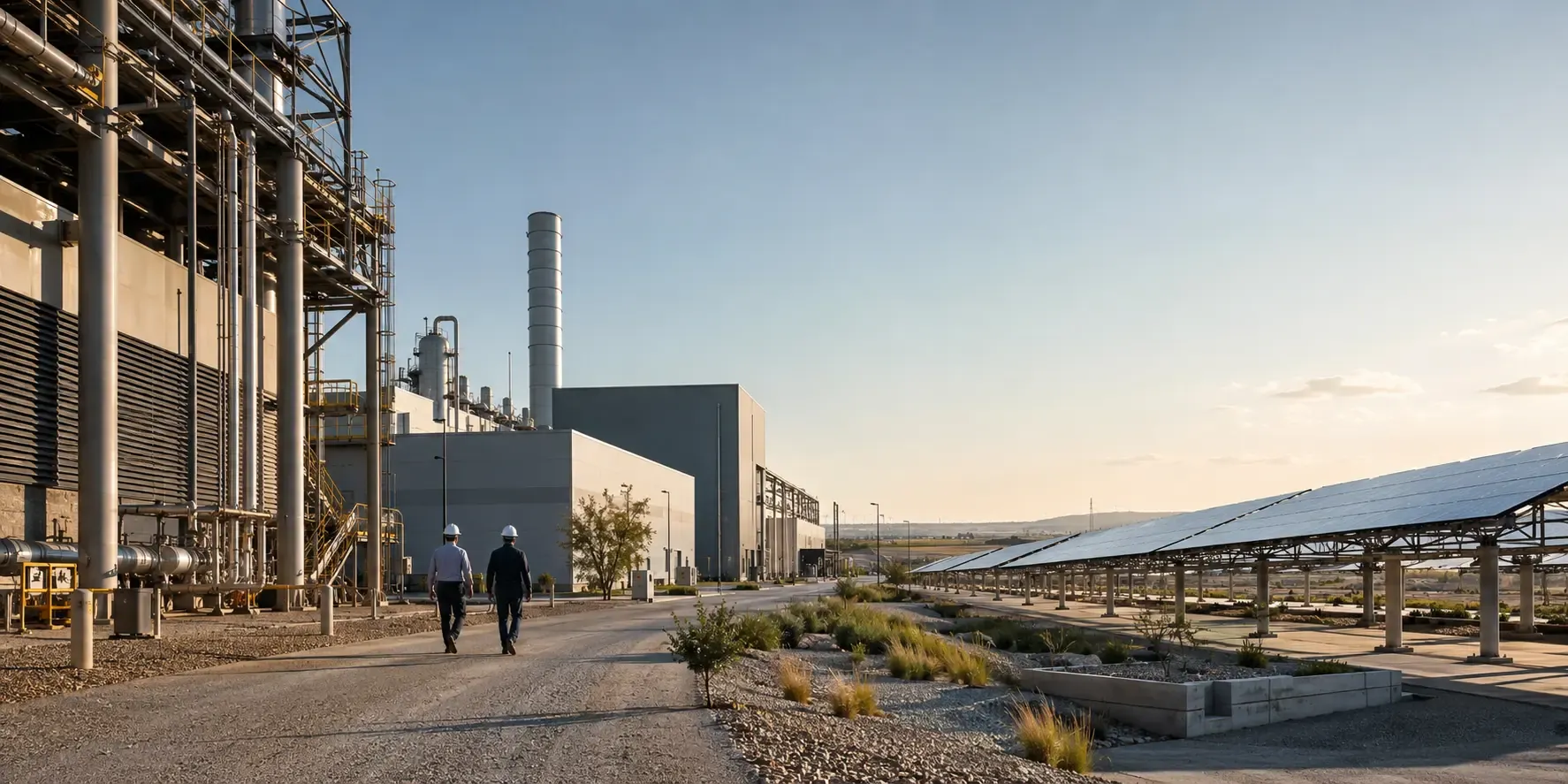



Verification engineers at an industrial facility
  1. Home
  2. Start from the claim, not from the standard.

Start from the claim, not from the standard.

Most people who arrive here are not looking for a standard number. They are looking for an answer to a question a buyer, a bank or a regulator has already put to them.

Route by question

Pick the question closest to yours.

The question you were askedThe service that answers itGoverning standards
“What were your company’s emissions this year?”Organizational GHG inventory verificationISO 14064-1 · ISO 14064-3
“Will your project reduce what you say it will?”GHG project validation and verificationISO 14064-2 · ISO 14064-3
“How much carbon does your product carry?”Product carbon footprint verificationISO 14067 · ISO 14064-3
“Does your neutrality claim hold up?”Carbon-neutrality claim verificationISO 14068-1 · ISO 14064-3
“Where will we fail before we even start?”Pre-verification readiness reviewNon-accredited review
“Our team does not know what will be asked of them.”TrainingGeneral programmes
“We need an ISO management-system certificate.”Global Energy Up certificationISO/IEC 17021-1
The first four services issue an accredited statement. The fifth issues no statement. The sixth is general training. The difference is stated on every one of their pages.
Accredited assurance

Four programmes, four different questions.

Engineer collecting operating dataISO 14064-1

Organizational GHG inventory verification

Your annual emissions figure, examined at source: boundary, source completeness, activity data, factors, calculation logic and the evidence trail behind each number.

ISO 14064-1:2018 · ISO 14064-3:2019


Engineer inspecting a renewable projectISO 14064-2

GHG project validation and verification

Validation looks forward at baseline, additionality and monitoring design. Verification looks back at what the monitoring data actually supports.

ISO 14064-2:2019 · ISO 14064-3:2019
Laboratory technician with product samplesISO 14067

Product carbon footprint verification

Functional unit, system boundary, allocation, primary and secondary data, the LCA model and the exact product claim — inside the sectors named in the schedule.

ISO 14067:2018 · ISO 14064-3:2019
Industrial site with solar generationISO 14068-1

Carbon-neutrality claim verification

The whole sequence: footprint, reductions actually implemented, residual emissions, credit retirement evidence and the wording of the claim itself.

ISO 14068-1:2023 · ISO 14064-3:2019
Around the engagement

Services that are deliberately not verification.

Pre-verification readiness review

The same method, no corrections, no statement, no accreditation symbol. You find out where you will fail while it is still cheap to fix.

How the separation works

Training

General programmes on ISO 14064, ISO 14067, ISO 14068-1 and CBAM evidence. No organization-specific solutions, no advantage in any later engagement.

Programmes

Assurance levels

Reasonable or limited, materiality, and the four types of opinion — what each one actually tells the person reading your statement.

What “verified” means

It follows from what is being asserted, not from what you would like to call it. An organisational inventory is verified to ISO 14064-1:2018; a project intervention to ISO 14064-2:2019; a product figure to ISO 14067:2018; a neutrality claim to ISO 14068-1:2023. All are performed to ISO 14064-3:2019. The pre-engagement review settles it before any quotation.

Validation examines a forward-looking assertion — that a project, as designed, should deliver what it claims. Verification examines a historical assertion — that what is reported actually happened and is supported by evidence. ISO/IEC 17029:2019 governs both.

No. Preparing the figure and independently examining it are separate roles, and combining them would destroy the impartiality the conclusion depends on. Preparation, readiness and training sit with a separate advisory entity; the verification decision stays here.

Reasonable assurance carries a positive conclusion and requires deeper testing; limited assurance carries a negative-form conclusion on a narrower base. The right level is the one the intended user needs — a regulator, a buyer or a board may each require a different one. It is fixed in writing before work begins.

Yes. If the evidence does not support the assertion at the agreed level, or the boundary or base data proves inadequate, we say so. A statement that could not be issued is a real outcome, and it is what makes the ones we do issue worth something.

Common questions

The questions that come before a contract.

These are the questions we are actually asked before an engagement starts. If yours is not here, ask it directly — a straight answer costs both sides less than a wrong assumption.

Request a pre-engagement review

Every question, in one place

Describe the claim — not the service.

Tell us what must be relied on, who will rely on it and by what date. We will confirm the correct programme, evidence requirement and responsible entity — or tell you it is outside our scope.